Interview with an expert:
how to explain art to children.
The purity of children.
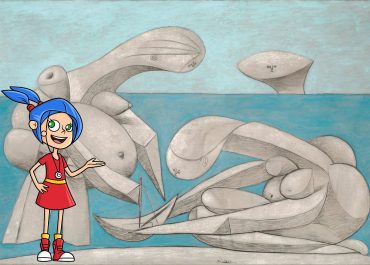
At first glance, Lisa looks like a pretty cool girl, original with her blue hair and a certain artistic flair, don’t you think so?! And that’s why today we ask her to give us some advice on how to explain art to children like her.
She accepts with a big smile and we start like this: “Hi Lisa! How do you think we can explain the history of art to children?“
“Do you know what Picasso used to say? “It took me twelve years to paint like Raphael, but a lifetime to paint like a child.” Isn’t it amazing that such a famous painter thought that there is more “art” in children than in the masters of painting!?”
And this was precisely the beginning of contemporary art! With Cubism, Picasso took as a model, among others, the art of children to find simpler shapes and colors.
Children have a unique ability to grasp the essence of things and express it with honesty
and immediacy: this easy observation brought new life to the traditional art.
How to observe a work of art: the point of view of children
Entering a museum full of works of art is like entering a new world: you need to find the right key and the right point of view to observe it.
Making this world accessible to a child is a true challenge for us: kids should never feel uncomfortable in front of a painting, works of art should never look like abstruse and distant objects to children, but things that they can become familiar with.
“Lisa, when we want to describe a painting, what do you recommend to start with?“
First of all, I like to know HOW the paintings were made: which technique and which materials were used. So maybe I can try it too!?!
In fact, if you really want to enter into communication with children, it is very important always to refer to their daily practice: when you describe a painting, you should compare it with something that kids can see or do in their own lives, as this way makes it easier for them to understand.
After all, as Kandinsky used to said, colors and lines are simple elements of a language, of a code that can be understood by everyone.
Then I like to know WHAT is depicted, what the painter wanted to tell. I like stories and I like symbols a lot, that is when objects and animals are used to represent hidden meanings. Then I get excited by paintings!
And this is perhaps the most fascinating and magical thing of all: art can raise EMOTION! Art is alive: it has a universal language, which can speak to our hearts, even after centuries.
One of the most interesting questions you can ask to a kid is: what kind of feelings does this very old painting evoke to YOU today?
How to visit an art museum: treasure hunts for children
The only thing – I confess – is that, sometimes, when there are too many paintings around, I get a headache!
This is actually the kind of mistake, that can ruin the experience! You can’t see too many paintings all at once!?! As always, it’s like too much of a good thing! After all, less is more.
The primary motivation for a child is curiosity that must be continually encouraged during the whole visit.
This is why scavenger hunts normally work so well with children, even in art museums: a kid-friendly tour of this kind, starting with a mystery to solve and ending with a little prize, really helps to arouse curiosity and interest of the little ones.
Venice Kids Tours offers two kinds of tours in art museums of Venice: a scavenger hunt in the Accademia (The big puzzle of the Venetian painting) to discover Renaissance Art and a scavenger hunt in the Guggenheim Museum (Peggy’s pizza) to discover Contemporary Art instead.

Children explain art to the grown-ups
And after a scavenger hunt, who understands more about art, children or adults? Could we say both, maybe in a different way!?
So, with respect to the initial title of our interview “How to explain art to children”, we might add that even children can always give us new and personal points of view, that we often miss!?
Anyway, that painting, you keep saying that is so beautiful, well, I don’t like it at all !!!
Lisa winks and makes a funny face at us, while she gets out of the chair.
Certainly, children have an advantage over adults: they have no prejudices in evaluating a work and have no filters in expressing out their opinion!? We should always listen to what they have to say: it’s a big mistake to underestimate them!
Goodbye Lisa and thank you for your useful advice!